
MINISTRY OF ENVIRONMENT
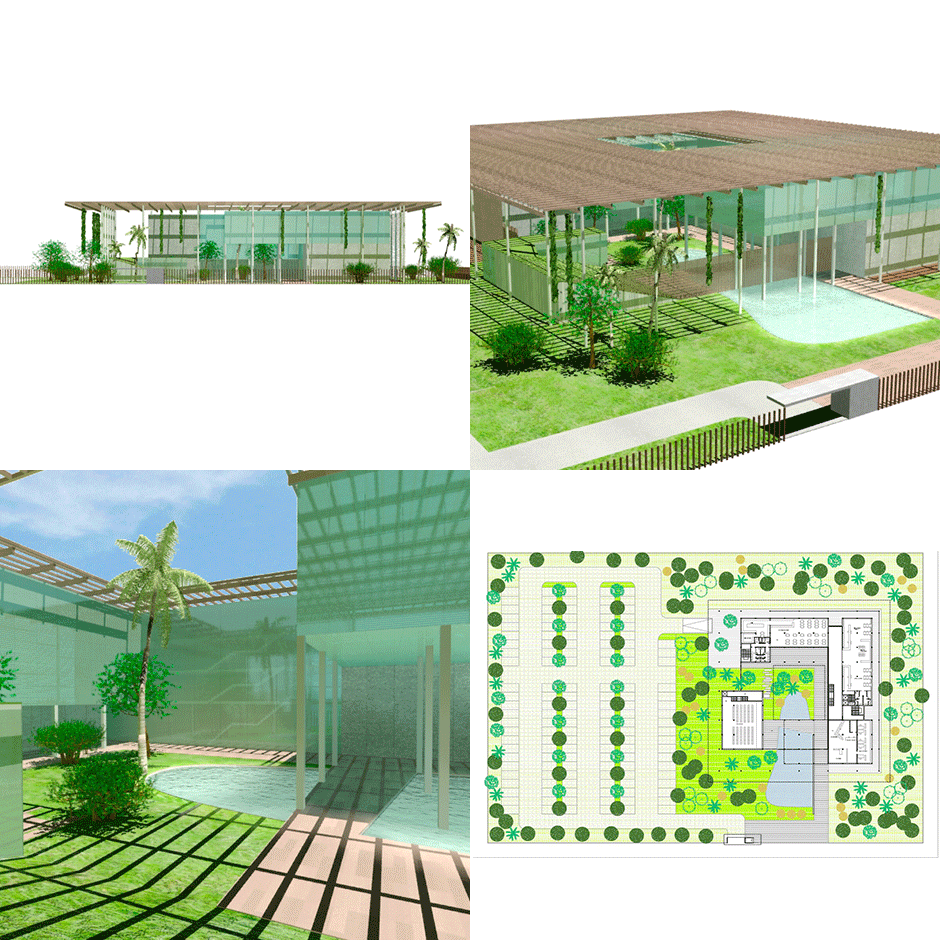
Project design for the new Ministry of Fisheries and Environment of Equatorial Guinea.
The project propose a building that lives and thrives on its environment, which has a great wealth and biodiversity. The building takes profit of the environment to organize itself around the green area which distributes the different parts of the building.
There is a pond which points the entrance and it is supplied by rainwater collected on the roof of the building. This pond naturally cools the environment.
The ground floor of the building is divided in: two blocks that conform the administration and offices area, including the bar-restaurant which organizes the space, and another block which emerges from the ground as a fissure and provides sunlight and it hosts the auditorium. The ground is used as natural isolation to get a comfort uniform temperature over the year.
Two of the facades of the administration buildings are large curtain walls that work as a big skylights which filter the sunlight in order to get uniform light inside.
The roof is a large latticework that filters the solar radiation. The administration volumes have a double skin that works as isolation and creates an air layer which cools itself through convective cycles.
The building collects the natural resources such as water, light and earth and it uses them as big comfort regulators of the interior.
Furthermore, all the materials used, come in a 70%, from recycled or sustainable materials.
In a composition level, the project aims to stress the geometry and its structure as a main characteristic. It primarily shows its natural heritage as a permeable and integrated building which takes benefit of its transparent volumes, such as public voids, atriums or corridors which create intermediate spaces that link the city and the building.
From a functional point of view, the ground floor determines the structural system of the project. Free plants and flexible work spaces are organized around a central space that provides light, natural ventilation and vegetation to circulation areas.
Finally, from a functional point of view, the building is designed with a modular, serial and economic construction system which defines, at the same time, its architecture characteristics and its savings and economics criteria.
The project considers the incorporation of sunlight in all the work spaces through a transparent perimeter and a central patio which provides zenithal light and acts as power lung. This patio produces the stack effect on summer and the greenhouse effect on winter.